Advocacy
2026 Legislative Priorities
Economic Security for All (EcSA)
WWA’s top priority is to enhance Economic Security for All resources to increase service levels and simplify the program’s administration. EcSA provides a state funding stream that aligns existing workforce and support programs across the state to amplify their collective impact. These funds are a critical resource that addresses the need to connect businesses with workers and sustain the infrastructure for individuals to receive
training and credentialing to be self-sufficient and achieve economic independence. EcSA funds primarily assist traditionally underserved communities, including
BIPOC, justice-impacted, and rural populations, in creating generational economic success by providing individuals with the necessary resources and support to thrive in the workforce.
EcSA core services received $12.338 million in the 2025-27 biennium operating budget, an $8 million reduction in direct funding. An additional $14.475 million from the Community Reinvestment Project (previously $48.25 million) will continue to partially supplement EcSA’s efforts to support marginalized communities and enhance economic development opportunities. Despite the significant funding drop, these remaining resources are critical to sustaining community-based programs that address economic disparities and promote
workforce development.
Position:
- Maintain funding for EcSA, adjusted for caseloads and inflation.
EcSA Makes Existing Government Programs More Effective
A recent study shows EcSA partnered with federal
Workforce Innovation and Opportunity Act (WIOA)
programs led to:
Stronger Earnings and Wages:
EcSA and WIOA co-enrolled participants = 28% higher wages
Greater Training and Service Access:
- 2x as many unhoused participants served
- Over 50% of EcSA co-enrolled participants
entered training, up from 13% in WIOA-only participants.
EcSA Impacts & Results
EcSA Results: July 2023 – June 2025
In the two years since EcSA was codified into law, the
combined results show a positive impact on our most
vulnerable Washingtonians:
- 6,634 job seekers were served statewide by EcSA
- 5-month average duration
- $2,925.96 average per-person cost to
provide services - Every individual who moves to self-sufficiency
saves taxpayers, on average, $29,892 per year - 54% BIPOC population participation
- 11% unhoused customer participation
$47,840 median wage upon completion compared to below $10,000 at enrollment
Return on Investment
Taxpayers and budget writers see an immediate return on investment. These are the annual returns and savings:
For every $1.00 the state invests in EcSA the state gets a return of $2.64
$25,348,575 total estimated return generated by EcSA July 2024 – June 2025 from a $9.6 million investment in Local Workforce Boards
$2,690,439 total estimated increase in sales tax revenue generated by EcSA July 2024 – June 2025
$22,658,136 total estimated benefit savings for the state generated by EcSA July 2024 – June 2025
The US Department of Labor has recognized EcSA as a best practice.
More information on EcSA can be found in ESD’s 2025 Legislative Report.
H.R. 1 Work Requirements & Access to Essential Benefits
WWA supports efforts to ensure that Washingtonians
affected by recent federal policy changes –particularly new work requirements for SNAP and Medicaid – can maintain access to essential benefits while transitioning toward self-sufficiency. These changes will impact more than 1 million residents statewide, including over 100,000 adults newly subject to SNAP work requirements. Programs like EcSA, WIOA Title I, and Basic Food Employment & Training provide training, supports, and career pathways individuals need to meet federal requirements, secure employment, and achieve long-term stability, but they are all underfunded and unable to meet the anticipated need.
Position
- Invest in workforce programs that help impacted Washingtonians meet new federal requirements while gaining skills and jobs.
- Expand coordination among DSHS, ESD, and Local Workforce Development Councils to ensure seamless access to approved training programs.
- Strengthen regional capacity to provide employment, training, and wrap-around supports in communities most affected by federal policy changes.
Community Reinvestment Project
WWA supports continuing the Community Reinvestment
Project (CRP), a vital initiative that addresses community empowerment, workforce needs, and justice-impacted individuals while promoting economic growth. Administered by the State Department of Commerce and in partnership with local Workforce
Development Councils, it uses a community-driven approach to guide the development and delivery of impactful programs to address racial, economic, and social disparities and help individuals develop or enhance their skills to move to self-sufficient employment and long-term economic stability for
themselves and their families.
Position
- Support continued funding for the Department of Commerce’s Community Reinvestment Project and its partnership with Local Workforce Development Councils to promote economic stability by helping individuals meet basic needs during career training,
assisting small businesses with grants and hiring support, and offering financial coaching and matched savings to build assets. - Ensure CRP is managed with transparency, accountability, and measurable results.
The US Department of Labor has recognized EcSA as a best practice.
More information on EcSA can be found in ESD’s 2024 Legislative Report.
Community Reinvestment Program Impacts
The Community Reinvestment Program (CRP) is a statewide effort designed to strengthen the workforce and economic development across Washington, prioritizing Black, Latine, and Tribal communities. Local Workforce Development Councils are working to implement key components of this project, including direct financial support to participants, support to help businesses grow and thrive, and Matched Investment Savings Accounts (MISAs) that help individuals build financial security. These efforts are designed to create meaningful pathways to economic stability and self-sufficiency for those most in need.
Results: December 2023 through September 2024:
12% Increase in job seekers served
from Black, Latine, and Tribal communities over a 1-year period
Career Accelerator Incentives
- Over 3,300 people served across Washington
- $21,788,000 distributed statewide
Business Support
- 9,500+ businesses have been engaged and supported statewide with grants, technical assistance, and training opportunities.
- Over 700 employees have direct funding through grants and training, helping them grow their business
- Over $5.6 million has been invested directly into local businesses, giving them the tools to train employees, build resilience, and grow
Financial Literacy: Matched Investment Savings Accounts
- 370 customers completed personal financial coaching and opened savings accounts.
- Over $5.5 million saved to help customers build long-term financial security.
Reinvestment Project Quarterly Report June 2025
Benefits Cliffs
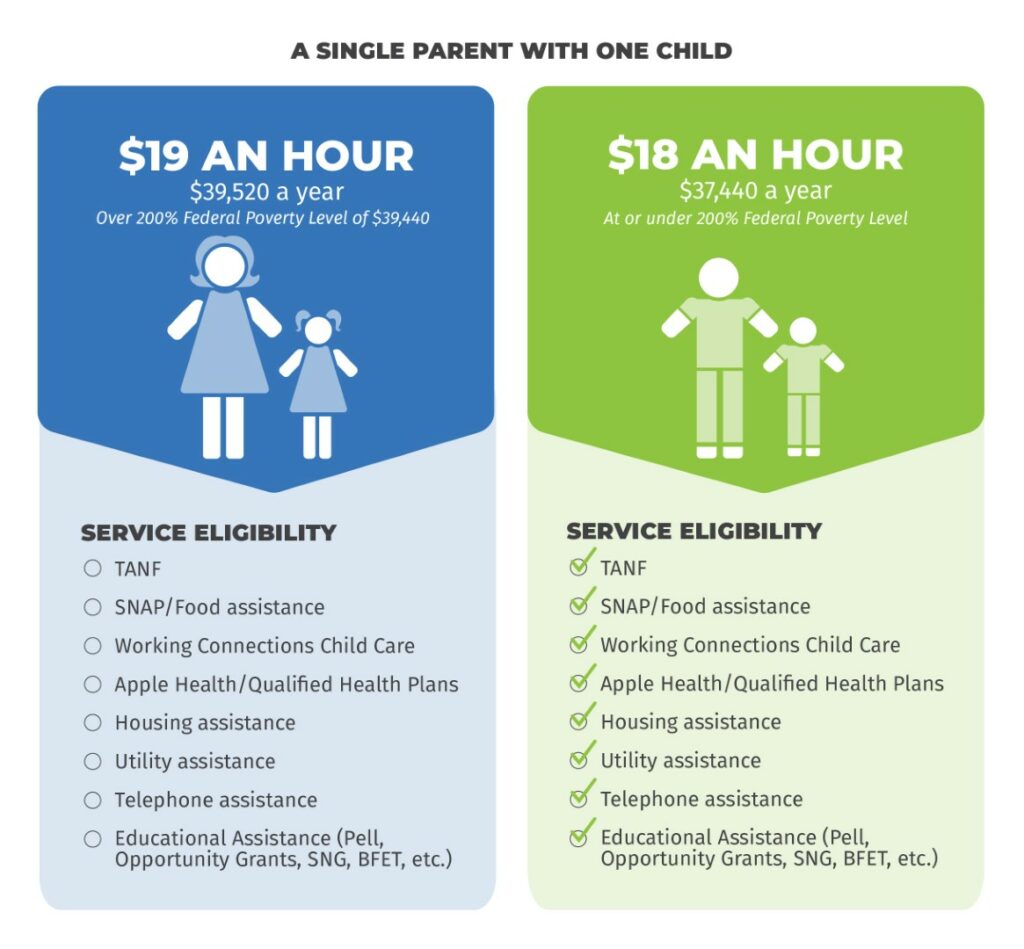
WWA recognizes the need to carefully manage benefits cliffs’ interaction with workforce development career pathways. Benefits cliffs refer to the sudden loss of public assistance, childcare, or housing when an individual’s income exceeds a certain threshold. While some benefit phaseouts are gradual, others are sudden and can significantly reduce income and resources for individuals and families, just as they are on the cusp of economic self-sufficiency. This is not only an issue
for families but also for employers’ ability to attract and retain key talent for their workplace. When people cannot afford childcare or housing, they leave their jobs, turn down new career opportunities, and forgo pursuing additional education. Wrap-around services coordinated through local Workforce Development Councils allow income gains through higher-paying careers while balancing the loss of public assistance in the near term, mitigating the impact of benefits cliffs on low-income households.
Position:
- Protect and enhance incentives for wrap-around services, allowing individuals to meet career goals and increase earning capacity while reducing government dependence.
- Support policies to address the housing shortage, emphasizing those who earn too much to qualify for low-income housing but struggle to afford housing near their workplaces.
- Promote legislative investments and solutions that grow access to affordable childcare options, meet the needs of parents with infants and school-age children, and invest in the people doing the vital work at childcare centers across our state.
Digital Skills and Education
WWA remains deeply committed to closing the digital divide, especially in rural and traditionally underserved communities. According to the National Skills Coalition, 92% of jobs require digital skills, but one-third of workers have low or no digital skills. As artificial intelligence reshapes the labor market, digital readiness now includes AI fluency and adaptive skill-building. A recent Microsoft analysis shows AI use exceeds 30% in Puget Sound counties but falls below 10% in many rural areas, underscoring the need for targeted efforts to ensure rural communities aren’t left behind in an AI-driven economy. Programs like Economic Security for All (EcSA) are helping deliver these services—integrating digital literacy, basic
education, and emerging technology skills to support economic mobility and workforce resilience. The Broadband Equity, Access, and Deployment (BEAD) grants aim to provide high-speed internet access to every person and business in the state by 2028; however, other efforts have stalled. Digital Equity Act grants were terminated in May 2025, the Digital Literacy and IT Career Equity program concluded in July 2025, and Digital Pathways were not funded in 2025, leaving several regional efforts paused pending future investment. Continued efforts
are necessary to ensure that every resident has internet access for education, training, job searches, running a business, or accessing necessities such as healthcare and groceries.
Position:
- Support the Washington State Broadband Office’s Broadband Equity Access and Deployment (BEAD) initiative and develop a comprehensive workforce development strategy that invests in skills and training for broadband deployment.
- Enhance efforts to promote digital literacy and provide marginalized communities pathways to high-demand, high-wage, information technology based careers.
- Address critical skills gaps locally through partnerships between employers, the 12 Local Workforce Development Councils, and education organizations.
Job Expansion & Creation
Local Workforce Development Councils (WDC) play a vital role in enhancing job opportunities and creation by advancing skills for today’s and tomorrow’s workforce. They foster economic growth, improve job quality, and promote prosperity through collaboration, strategic planning, and effective workforce programs. WDCs strategically align partnerships and braid federal, state, and local resources to deliver coordinated services that drive job creation and economic mobility in underserved communities. WDCs partner with employers, economic development councils, and other community partners to form a responsive frontline system that develops workforce plans and bridges gaps between job seekers and industry needs.
Position:
- Support strategies to increase outreach, capital, tools, and technical assistance to stimulate business, particularly in underserved and rural communities.
- Ensure job creation policies include locally led workforce development initiatives.
- Ensure a solid foundation is in place to train, retrain, and upskill workers to meet the needs of the Clean Economy employers and projects.